
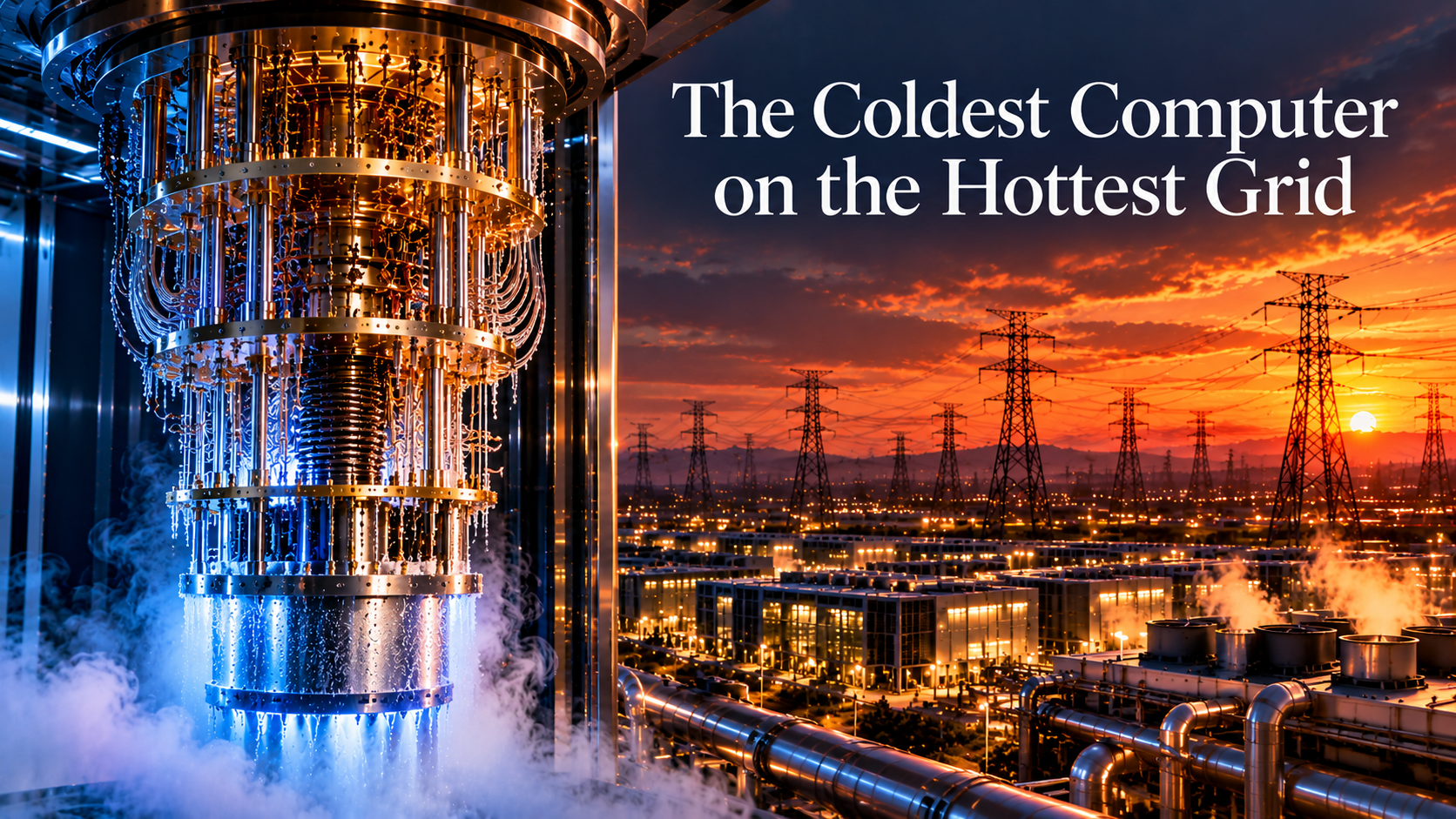
Everyone is modeling how much power AI will burn. A second machine is arriving on the same grid, and it runs in the opposite direction, spending megawatts to pull a chip colder than deep space. Here is why the cold load belongs in your capacity plan now, while it is still small.
The Coldest Computer on the Hottest Grid
The AI power debate has a second half that almost nobody is modeling. Everyone is arguing about how much electricity data centers will pull to run AI. Set that aside for a moment, because another machine is arriving on the same grid, and it works in the opposite direction. A quantum computer does not spend its energy making heat. It spends energy removing it, pulling a small chip down to a temperature colder than deep space and holding it there. The grid underneath does not care which way the heat flows. It sees load either way.
Why does a quantum computer need to be colder than space?
A quantum processor only works when it is almost perfectly still. At ordinary temperatures, the faint thermal motion inside any material is enough to knock a qubit out of its state before it can finish a calculation. So the chip is buried inside a dilution refrigerator and cooled to around 15 thousandths of a degree above absolute zero. IBM's Condor processor runs below that mark. For comparison, the average temperature of outer space is about 2.7 degrees above absolute zero, which puts the inside of one of these machines more than 150 times colder than the vacuum between stars. We are manufacturing the coldest spot in the known universe on purpose, in a building, on a utility connection.
Where does the energy actually go?
Here is the part that surprises people. The qubits themselves sip power, a matter of milliwatts. The energy bill is almost entirely the refrigerator. Google's Sycamore, the 53 qubit machine behind its 2019 quantum supremacy claim, ran on roughly 26 kilowatts, and the overwhelming share of that went to cooling and control rather than computing. The chip is the cheap part. The cold is the expensive part. That alone should reframe how people argue about this technology. The familiar question, will quantum save energy or burn it, is pointed at the wrong object. The computing was never the cost. The refrigeration is.
And the cold does not run alone. The headline problem in quantum right now is error correction. A single reliable qubit can take thousands of physical ones to sustain, and correcting all of those errors has to happen continuously, in real time, on conventional computers running right next to the cold machine. So the exotic cryogenic system needs an ordinary room of classical processors beside it, doing the bookkeeping and drawing ordinary power. The cold chip needs a warm computer to keep it honest. The overhead everyone counts in qubits has an electricity bill on both ends, and almost no one shows it.
Why doesn't this get cheaper as it scales?
For fifty years we have been trained by one pattern. Transistors got smaller, cheaper, and cooler per unit, year after year, and our entire intuition about computing assumes that curve keeps going. Cooling does not follow it. A dilution refrigerator has to hold its temperature whether the machine is working flat out or sitting idle, so the draw is largely fixed and it runs around the clock. Push toward the machines that fault tolerance actually requires, hundreds of thousands or even millions of physical qubits, and you do not get one clever refrigerator. You get many, plus the wiring and control electronics that come with every qubit, none of which shrink the way transistors did. The thing getting cheaper per unit in a classical chip is the thing getting more expensive per qubit here. That is a very different curve to plan a facility around, and it bends the wrong way.
What does this mean for the grid you are planning around?
If you are siting compute for the next decade, you may end up with two loads that behave like opposites under one roof. One hall full of processors dumping megawatts of heat into the air. Another hall spending megawatts to pull a few chips down toward absolute zero. Opposite problems, same substation, same interconnection, same bill. The demand curves utilities and developers are modeling today assume a particular kind of load, a hot one that rises and falls with how hard the machines are working. A cryogenic load does not track effort that way. It runs steady, and it runs cold, and in most forecasts it is not there at all.
I spent years in operational energy, and the lesson that keeps proving itself is that the load you fail to plan for is rarely the one you were watching. Right now the whole industry is watching AI's appetite for power, and it is right to. Quantum is small today, a handful of machines, easy to wave off. So was every load that later mattered, back when it was still small enough to ignore. The useful question is not whether quantum becomes a serious draw next year. It is whether the people drawing up capacity for 2035 have left a line anywhere for a machine whose entire purpose is to get cold, sitting on a grid that is already being redrawn by the machines that run hot.
The coldest computer and the hottest grid are heading for the same meter. When they meet, which plan on your desk already has a place for it?

Nina Khan, Energy Strategist · Public & Private Sector Energy
Certified Energy Manager (CEM) with eighteen years in public and private sector energy.
More about Nina Khan →Have a power, cost, or resilience question? Let’s talk.