
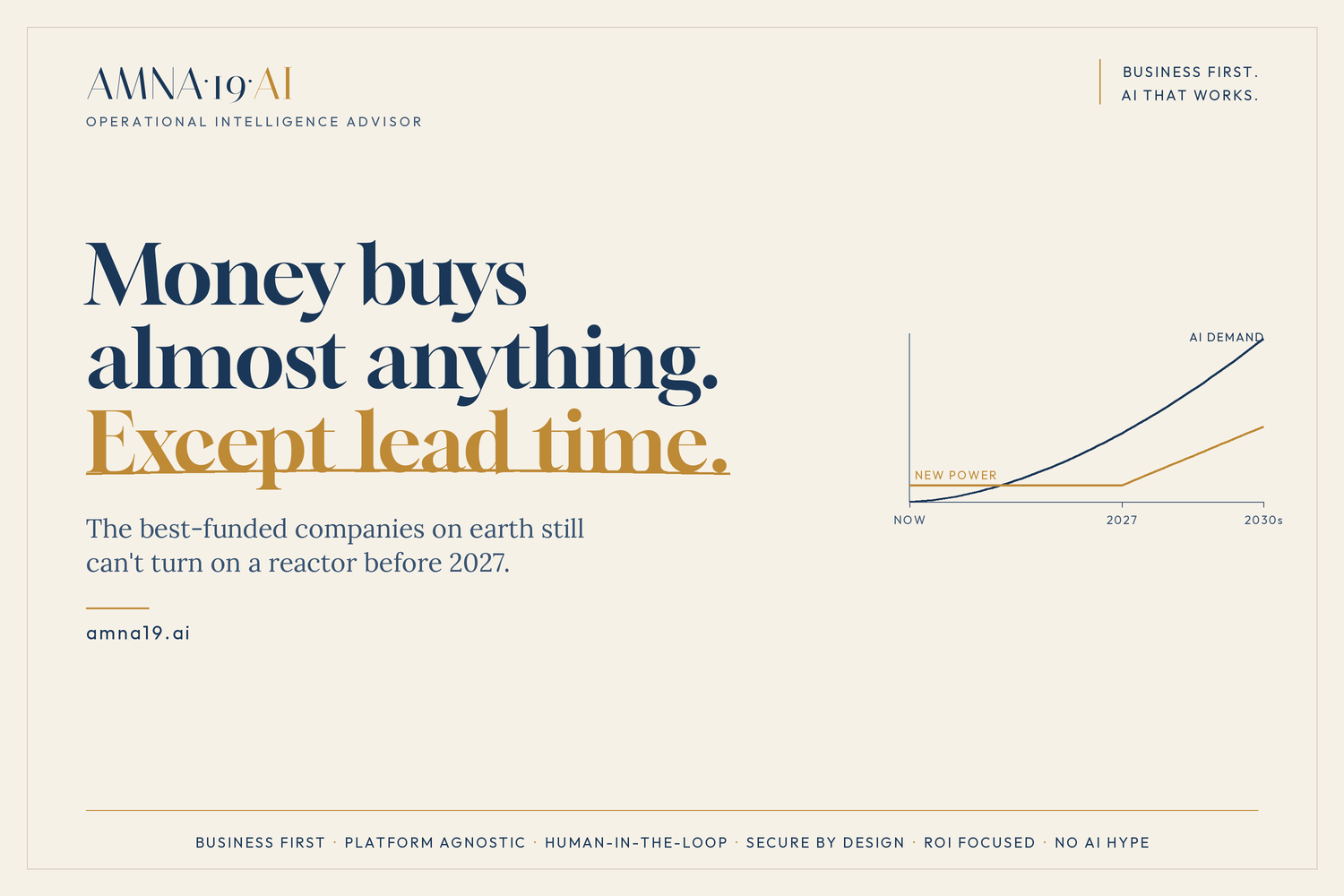
The biggest companies on earth are buying nuclear plants to power their AI, and still can't turn one on before 2027. The lesson isn't about planning ahead. It's that money buys almost anything except time.
Here's a shift that's easy to miss under the AI headlines. The biggest technology companies are quietly becoming power companies.
They can't pull enough electricity from the grid to run their AI, so they've stopped waiting for it and gone to the source. Microsoft signed a deal to restart a reactor at Three Mile Island. Across the four largest players, there are now around a dozen nuclear deals in motion, close to ten gigawatts of planned capacity.
Notice what that really is. Some of the most disciplined capital allocators in the world just decided to vertically integrate into power generation, a business they have no history in and no obvious right to win. Companies don't buy their way upstream into something that far from their core unless the constraint is real and structural. When you see the best-run companies integrating backward into a supply they used to simply purchase, that's the tell. The scarcity isn't a passing spike. It's the new shape of the problem.
And here's the part that should stop you. It sounds like they've solved it. They haven't, not for years. Most of that power doesn't come online until 2027 at the earliest, and much of it lands in the 2030s. You cannot speed up a reactor with money. Permitting, construction, and fuel supply run on their own clock, and that clock does not care how large your balance sheet is.
That's the real lesson, and it isn't the obvious one about planning ahead. Money can buy almost anything except lead time. The richest companies on earth, facing an existential need, still have to wait. Which means the advantage in a constrained market quietly moves. It stops belonging to whoever can spend or move fastest, and starts belonging to whoever secured the slow input earliest. First-mover advantage attaches to the things you can't rush.
Your business runs on the same rule, at a smaller scale. You have your own version of the reactor. Something with a long runway you can't acquire the week you finally need it. A person trained deeply enough to run a function without you. A process mapped well enough that someone else can pick it up. Neither one can be bought on demand. Each takes months of quiet effort that feels skippable right up until the moment it isn't.
The trap is that you can fund nearly everything else instantly. A tool, or a contractor. So the fast inputs get your attention and the slow ones get deferred, and the slow ones are the exact things that bind when you grow. By the time the limit shows up, the fix is measured in quarters, not days.
The hyperscalers at least saw their wall coming and had the resources to start early. Most businesses don't see theirs at all, because a slow constraint doesn't announce itself. It's quiet, and it looks fine, right until it's the only thing standing between you and your next stage.
You can't build a reactor. But you can find the slow constraint inside your own operation while there's still time to do something cheap about it. That's the part I help with. A quick look, no login, and I won't touch anything on your site. Want me to help you spot it? amna19.ai

Nina Khan, AI Architect · Public & Private Sector Energy
Certified Energy Manager (CEM) with eighteen years in energy strategy and operations across defense, government, and commercial real estate.
More about Nina Khan →If this article sounds familiar, your business may be experiencing unnecessary Business Friction™.
Let’s Talk.