
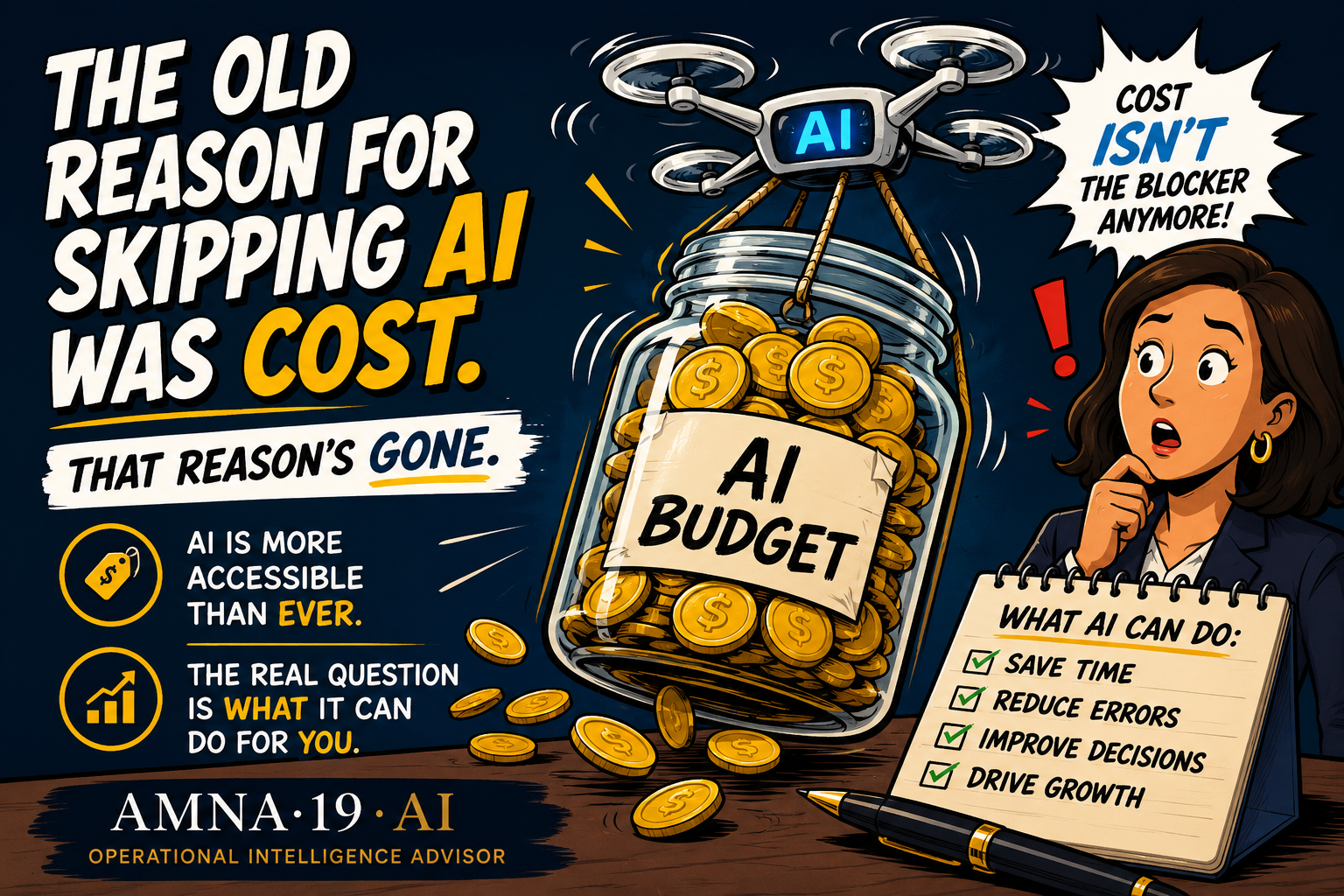
AI stopped being expensive. The typical small business now spends about $28 a month on it. So the real question isn't which tool to buy. It's where your business is quietly losing time, and whether you've pointed anything at it.
The old reason for skipping AI was cost. Too expensive, not built for a business this size. I heard it constantly.
That reason's gone.
The JP Morgan Chase Institute tracks what businesses actually spend, not what they claim on a survey. By their numbers, the typical small business now puts about $28 a month toward AI. In 2022 it was closer to $80. A lot of the starter tools are free. The gap between what big companies use and what small ones use used to run almost two to one. Last year it closed to about 1.2 to one.
So if the price tag was your reason for waiting, you can let it go.
Here's what took its place. When AI cost real money, you were careful. You bought one thing and watched whether it earned its keep. If it didn't, you cut it. Cheap took that care away. Now people switch on a tool in one corner, flip a setting in another, and never check whether any of it did anything.
The numbers say the same. Around two-thirds of small businesses will tell you they use AI regularly. But ask how, and most have nothing behind it. No plan. Nobody watching whether it helps. A lot of "yes, we use AI" is someone who opened ChatGPT a few times last winter and moved on.
So the question isn't which tool to buy. It's where your business is losing time.
That's never the exciting part. It's the question your front desk answers fifteen times a week. It's the handoff where a job sits for a day because nobody's sure it's their turn. Sometimes it's work that gets done, then redone, because the first pass wasn't right. Dull stuff. But it lands on your books as hours you paid for and got nothing back.
Here's the kind of thing I mean. Say you run a clinic. The front desk fields the same couple of questions all day. Hours, and whether you take someone's insurance. Every call, the same answers, while whoever's standing at the desk waits. That doesn't need a big system. A short set of answers the phone can handle, plus a text-back for after hours. An afternoon of setup. The front desk gets their mornings back, and callers stop landing in voicemail.
Point a $20 tool at one of those and it pays for itself fast. Buy a stack of pricey ones and aim them at nothing, and you've spent more to stay where you were. What you get back doesn't come from the price of the tool. It comes from what it takes off your plate.
One thing worth saying plainly: don't automate a mess. Put AI on top of a broken process and you get a faster broken process. Find where the work snags first. Look at the three or four things your team does by hand every week. Pick the one that costs you most. Go after that one. Give it a few weeks. See if it moved. Then take the next.
That's less about technology than about knowing your own shop well enough to see where it drags.
The cheap tools are good news. You don't need a big budget to keep up anymore. What you need is an honest look at where your own business gets stuck. That's where the money's actually hiding.
I work with service and e-commerce owners to find where the work snags and clear it. If you're not sure where yours is, that's what the Business Friction Assessment is for. Want me to take a look? amna19.ai

Nina Khan, AI Architect · Public & Private Sector Energy
Certified Energy Manager (CEM) with eighteen years in energy strategy and operations across defense, government, and commercial real estate.
More about Nina Khan →If this article sounds familiar, your business may be experiencing unnecessary Business Friction™.
Let’s Talk.