
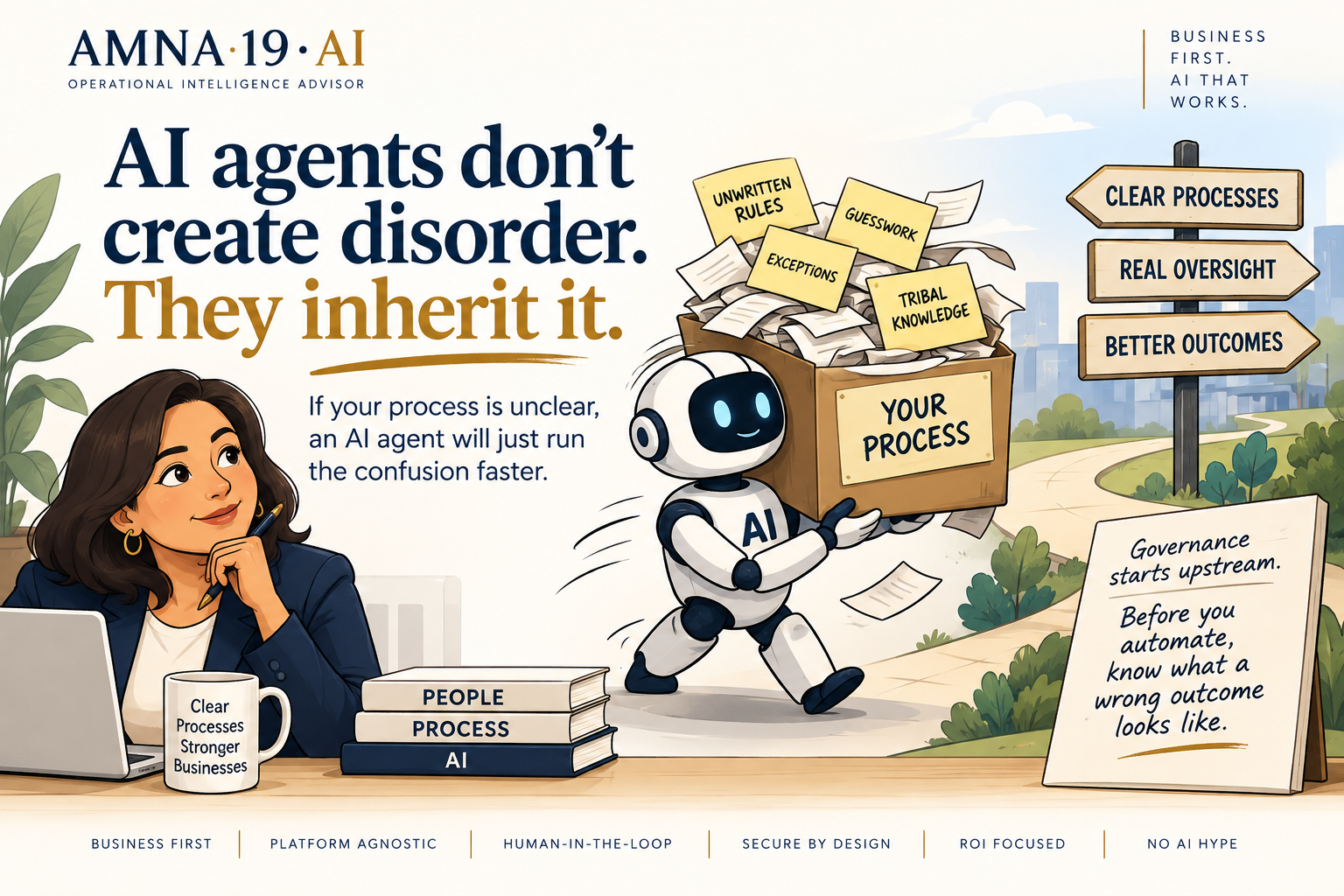
The five-pillar governance frameworks aren't wrong. They skip the part that decides whether any of it works: whether you understood the process before you handed it to a machine.
Every few weeks another AI agent governance framework makes the rounds. Five pillars, sometimes seven. Identity, access, oversight, monitoring, risk. None of it is wrong. None of it is the hard part either.
Those pillars describe the paperwork you put around an agent once it exists. They skip the thing that decides whether the paperwork means anything, and that thing sits upstream of all of it.
Start with what an agent actually does to a process. It doesn't bring order to it. It inherits whatever order was already there. And most processes run on a layer of human judgment nobody ever wrote down.
Here's what I mean. A support lead approving refunds doesn't follow a rule that fits on a card. They look at the request and know things. This customer has asked three times this month. That one has a real problem. The number on the screen is only part of the decision. Hand that task to an agent with a clean rule, approve anything under fifty dollars, and you'll either wave through the person gaming you or block the person with a real complaint. The discretion was the control. The agent can't inherit what was never written.
So the first governance question isn't about the agent at all. It's whether you can say, in plain terms, what a wrong outcome looks like in this process. If you can't define the bad result, monitoring won't save you. You'll collect tidy logs of decisions you have no way to judge, and call it oversight.
Which brings up the pillar most people get wrong. Human oversight sounds like the safe answer, so everyone claims it. But a person approving two hundred agent actions a day isn't overseeing anything. They're clicking approve until they stop reading, and that happens faster than anyone admits. Real oversight means choosing in advance the few decisions that truly need a human hand, and letting the rest run without one. That is a design decision you make once, early, not a checkbox you staple on at the end.
One more thing, and it's easy to skip. Don't tie your governance to a single vendor's controls. The model underneath you will change, probably more than once. If your rules live inside one provider's settings, they leave when the tool does. The governance has to live in your process, where it survives the swap.
None of this is exotic. It's the same discipline as handing real work to a new hire you can't watch all day. You give them what you've defined well enough to check, and you keep the rest close until it's clear. An AI agent earns trust the same way, on the same terms.
The catch is that most businesses discover their process was never as defined as they thought, right at the moment they try to hand it off. Better to learn that on purpose than in production.
If you want to know whether a process is ready to hand off before you automate it, that's the part I help with. A quick look, no login, and I won't touch anything on your site. Want me to take a look? amna19.ai

Nina Khan, AI Architect · Public & Private Sector Energy
Certified Energy Manager (CEM) with eighteen years in energy strategy and operations across defense, government, and commercial real estate.
More about Nina Khan →If this article sounds familiar, your business may be experiencing unnecessary Business Friction™.
Let’s Talk.