
Everyone is racing to find more power for AI. The harder problem, and the one almost nobody is pricing in, is how long it takes to connect that power to the grid. Here is why the queue to get connected, not the ability to generate, is the real limit on how fast AI can grow.
AI's growth is bumping into an energy limit, but not the one most people name. The country is building plenty of power. What takes years now, and what actually caps how fast AI can grow, is getting that power connected to the grid.
Is the real energy bottleneck generation or the interconnection queue?
For two years the AI energy story has run on one number: gigawatts of generation. How many a hyperscaler needs, which retired plant is being restarted, whether the country can produce enough. That is the wrong number to watch. Generation is not what holds these projects back. They stall at the point of connection.
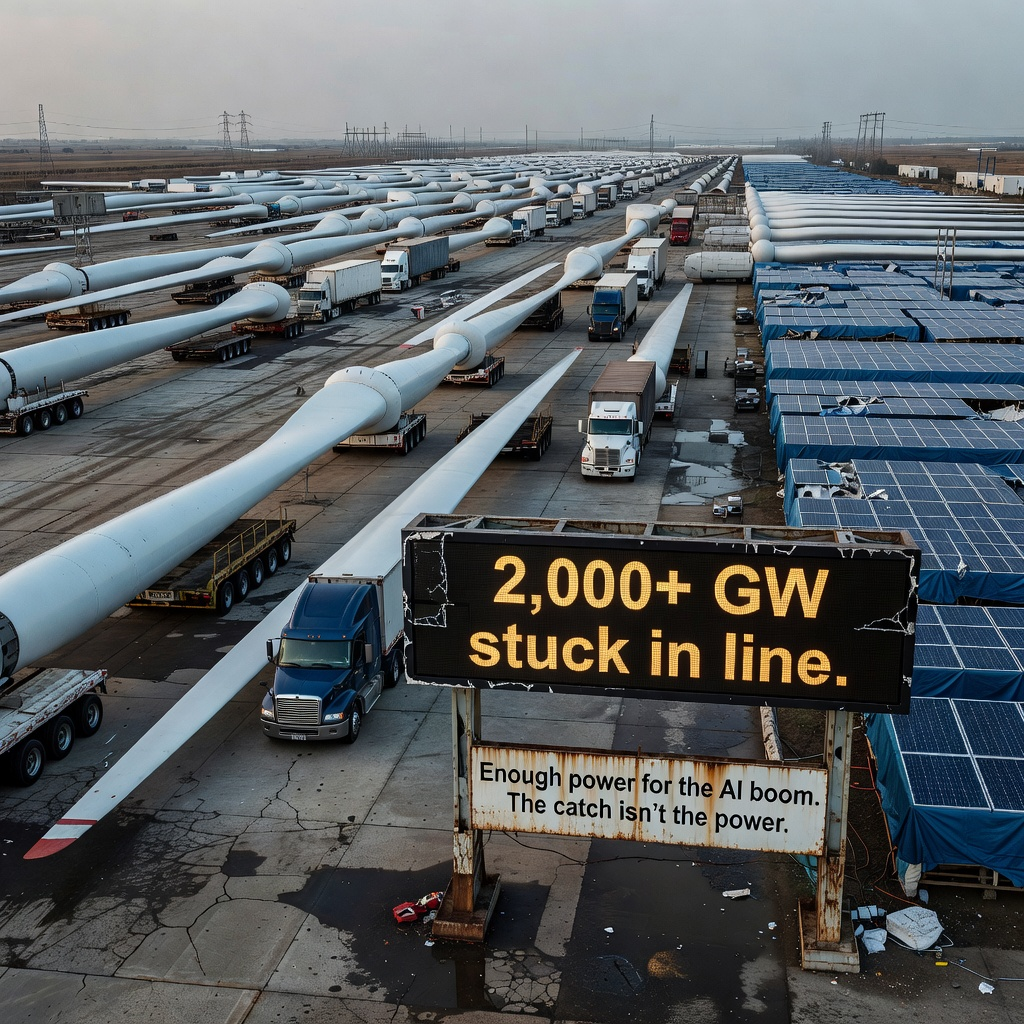
Look at what is actually waiting. Lawrence Berkeley National Laboratory tracks every project trying to join the grid in its annual Queued Up report. The 2026 edition, with data through the end of 2025, counts more than 2,000 gigawatts of generation and storage sitting in interconnection queues. That is more than the entire installed generating capacity of the United States. Very little of it is stuck for lack of money or lack of demand. It is stuck in the process of being studied, approved, and physically connected.
That process keeps getting slower. The median project reaching operation in 2025 spent over five years in the queue, up from under two years about fifteen years ago. I saw how this works up close long before AI made it a headline. Around 2015 I was working on the energy side of a commercial real estate portfolio, and we had a high rise with a two megawatt generator, far more capacity than the building itself would ever draw. The plan was simple on paper: sell the surplus power back to the utility, in that case Pepco. Getting the interconnection agreement in place took two years, and then some. One building, one generator, a utility that wanted the power, and it still took that long. None of the delay was technical. It went to the process of getting permissions to connect. That was a single building a decade ago. The same forces are now bearing down on gigawatt scale projects, all at once.
Why can't AI data centers just buy their way to power?
This is where the AI build out meets something it cannot outspend. A data center shell can go from groundbreaking to commissioned in roughly 18 to 24 months. The power to run it takes far longer to arrive. In Northern Virginia, the largest data center market in the world, the wait for a grid connection has reached about seven years, according to the 2026 JLL Global Data Center Outlook. Dominion, the utility serving that region, has said it cannot take on new large load connections there through 2030.
Everything else can be ready on schedule. The financing, the land, the building, the hardware, all of it can line up. The connection is the piece that will not, and nothing else on the list can stand in for it. A company that can finance a gigawatt waits in the same line as everyone else, and the line does not move faster for being well funded.
Demand is lengthening the line. On the Texas grid, large load interconnection requests climbed from about 63 gigawatts to more than 226 gigawatts in a single year, and close to nine in ten of those requests came from data centers. New requests are arriving far faster than connections are being completed, so the wait grows even as everyone agrees the power is needed.
What does the connection wait do to an AI energy strategy?
It changes what the real decision is. The question stops being where to buy power and becomes where power can actually be connected, and by when. The second question is harder, because the answer depends on study backlogs, transmission that has to be built, equipment that has to be ordered, and a utility workforce that was never sized for this pace.
The equipment side deserves a mention, because it has quietly moved the bottleneck past the queue itself. A large power transformer, the kind a major connection requires, now carries a lead time of roughly two and a half years, according to Wood Mackenzie. A project can clear every study on schedule and still sit idle waiting for a single part. The delay has spread out of the paperwork and into the supply chain.
The operators getting ahead treat power as the first constraint rather than the last. Some secure a queue position years before they break ground. Others build generation on the site itself, so they can run while the full grid connection is still being studied. What they share is a decision to stop choosing locations by land price or tax incentive and start choosing by how fast they can actually get connected.
Is this a grid build problem or an operations problem?
Here is the part that gets missed. A wait of five or seven years sounds like a physical problem, the kind solved by pouring concrete and stringing wire. Much of it is not. The delay lives in process more than in physics. Studies get redone and queues fill with projects that will never be built, while planning and interconnection run as separate tracks that rarely talk to each other. Berkeley Lab found that only about 19 percent of the projects that entered queues between 2000 and 2019 ever reached operation. Each of those dead projects slowed the live ones behind it.
That is a coordination problem at least as much as a construction problem. It has the same shape as something I spent years watching inside large organizations that had every resource they needed and still moved slowly, because the way the work was organized had not kept up with the size of the work. The grid is in that position now, at a national scale. The reforms moving through the grid operators, faster study cycles and stricter queue rules, are aimed at the operational side, and in the near term they will matter more than any single new plant.
For the people making these calls, whether they run a utility, develop sites, operate data centers, or manage energy at a large installation, the useful move is to stop waiting for the grid to catch up and plan as though it will not, at least not on your schedule. The ceiling is real and it is measured in years. The advantage goes to whoever reads the queue honestly and builds around it.
The ability to generate power in this country is not really in question. Whether we can connect it fast enough to matter is, and for now the honest answer is that we cannot. So here is what I would ask anyone planning a major energy or compute project: how soon can you actually connect the power you are counting on, and does your plan still work if that answer is years away?
So here is the question for anyone siting a large project right now: in your market, has the wait to connect already become a longer line than the build itself, or not?

Nina Khan, Energy Strategist · Public & Private Sector Energy
Certified Energy Manager (CEM) with eighteen years in public and private sector energy.
More about Nina Khan →If this article sounds familiar, your business may be experiencing unnecessary Business Friction™.
Let’s Talk.