
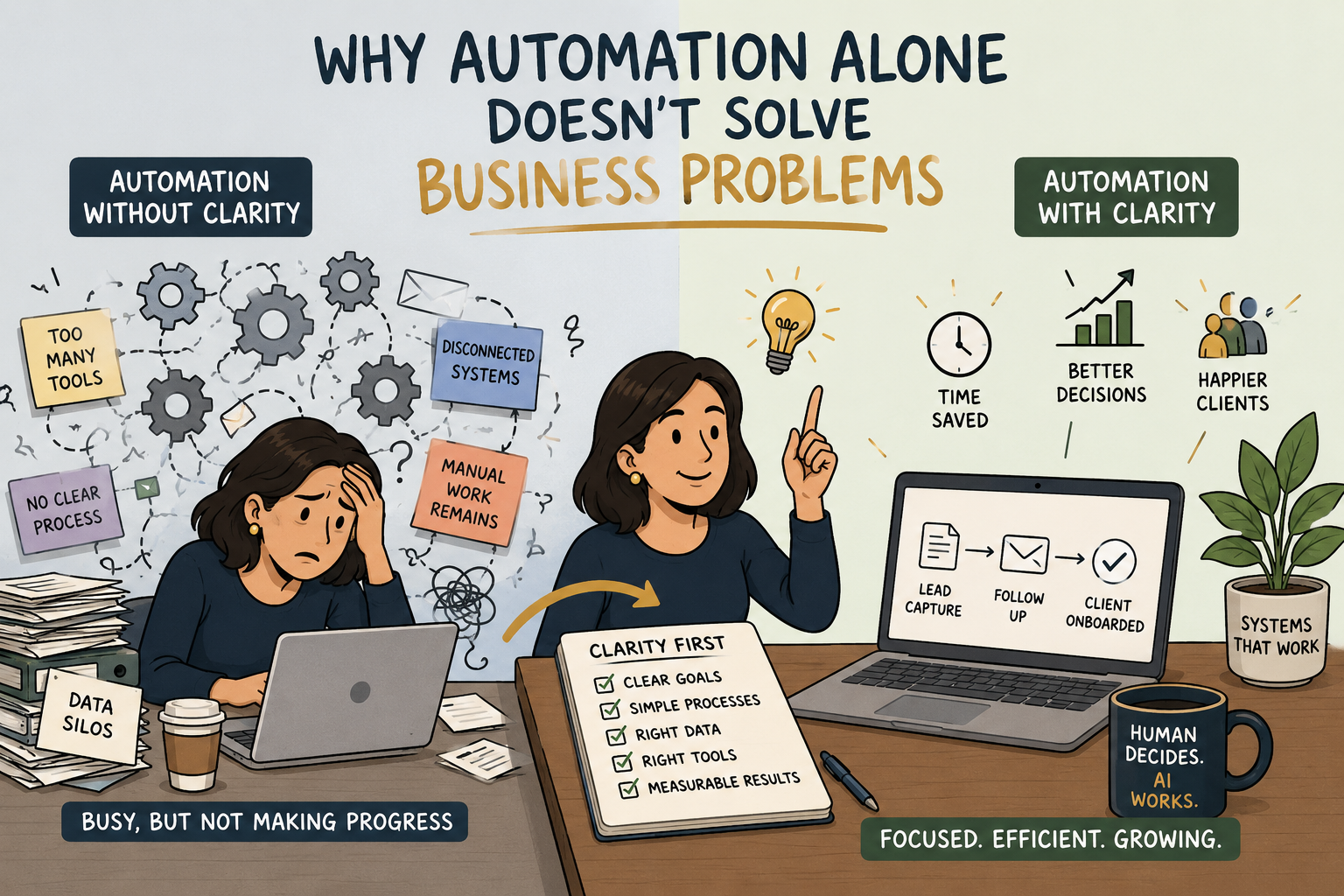
Automation amplifies whatever it's built on. On a good process, that's a gift. On a broken one, it just hides the problem and speeds it up.
Automation gets sold as a fix. It's really a multiplier. Point it at a process that works and the work gets faster. Point it at a broken one and you speed up the breaking.
So before you automate anything, write down what really happens now. Not the tidy version. What goes on step by step on a normal day. Most of the time, writing it out is enough to show you where the trouble is.
Here's what I mean. An owner I talked to had a new-client intake that was a mess. Details came in by email, got typed into a spreadsheet, then typed again into the billing system. So they automated it. Now the intake form fed straight through on its own. Faster, sure. But the form asked the wrong questions, so the gaps just showed up quicker, and the same back-and-forth to fix them still happened, only now nobody could see where it started. The automation didn't cause the problem. It hid it.
We fixed the form first. Asked for the right things up front, cut one of the two entries, made sure each field had a clear home. Then automated what was left. Same tool, completely different result, because the process underneath it actually worked.
The rule I'd keep is simple. Don't automate a process you can't describe on one page. If you can't lay it out plainly, speed won't help. It'll hand you the same mess, faster.
Then sit with a few questions before you flip anything on. If I automated this today, what would break? Who owns this start to finish? If it broke, who'd fix it, and what would that cost?
None of it takes long. And it saves you from speeding up something that was never working in the first place.
If you're not sure whether a process is ready to automate, that's the part I help with. A quick look first, no login and nothing touched on your site. Want me to check? amna19.ai

Nina Khan, AI Architect · Public & Private Sector Energy
Certified Energy Manager (CEM) with eighteen years in energy strategy and operations across defense, government, and commercial real estate.
More about Nina Khan →If this article sounds familiar, your business may be experiencing unnecessary Business Friction™.
Let’s Talk.